Keywords: Cultural Revolution China, Mao Zedong, China 1966, Historical fiction, Resilience, Humanity vs. cruelty, Struggle sessions, Red Guards
Genre: Historical fiction
Length: short medium long
Country: China
Review

I came across The Morgue Keeper while browsing NetGalley, specifically looking for East Asian authors. The first thing that drew me in was the cover — starkly minimalistic, just a mosquito in the middle. It felt ominous and intriguing, like something I would be interested in. The description itself didn’t reveal much, so I expected a horror-tinged, grotesque story — unsettling, but not extreme. I requested it anyway.
When I began reading, I quickly had to double- and triple-check whether this was truly a debut novel. The writing was exceptional. Not just the prose, but the entire architecture of the novel — the atmosphere, the pacing, the restraint where restraint was needed, and the unflinching detail where silence would have been dishonest. From the very first page, I knew this book was special.
The story of The Morgue Keeper
We are introduced to Qing Yuan, a morgue keeper, and almost immediately immersed in the routines of his grim workplace: how bodies are delivered and what happens when no one comes to claim them. The descriptions are meticulous, but what truly strikes is the atmosphere — suffocating, heavy, gruesome. Whether the scene unfolds inside the morgue or outside on the streets, the weight never lifts.
One early moment sets the tone for the novel’s haunting humanity. A body arrives so utterly desecrated that even Qing Yuan, who has seen everything, is shaken. No one comes to claim her, and like all unclaimed bodies she is destined for incineration, faceless and nameless. But Qing Yuan refuses to let her be erased. He calls her “#19” and makes a promise — to discover who she was and what happened to her. He has no duty to her, no connection, no reason beyond compassion. And yet he takes it upon himself to honor her existence, to offer the dignity the world denied her. This pledge becomes one of the novel’s quiet but profound plotlines, and by the end of the book, we are given answers. The arc closes in a way that is both heartbreaking and beautiful, a testament to the persistence of humanity even in the darkest times.
She had been a human once, good or bad, it made no difference. She had been utterly desecrated, utterly destroyed, then sent to him as though she were toxic waste. No one had come to claim her, no one had sent her clothes. She’d been trundled off on a dirty tricycle by a sad man whose life, like Qing Yuan’s, amounted to ferrying the dead from this sad world out into a cosmos that, as Lao Jia never failed to insist, was waiting for us all.
Qing Yuan has a colleague, Lao Jia, and some neighbors, and we begin to see his world and routines — even the grim shorthand among coworkers, “how many,” referring to the number of bodies that day. For a brief moment, it feels like this suffocating rhythm is their normal. But then everything shifts. Qing Yuan is accused of being a counterrevolutionary. He is taken away, imprisoned, and from there the narrative plunges into the nightmare of torture, struggle sessions, and the spectacle of dehumanization.
“Where is your law now?” The gynaecologist said. “Where is your righteous court?” “This is illegal, we have the right to…” “We have nothing”, the lab director said. “No rights, no law, nothing.” “The party could never do wrong a good person”, the surgeon said. “Then you must be very bad”, the pediatrician said.
What follows is harrowing, and Ruyan Meng spares us nothing. She describes the humiliations, the physical and psychological tortures, the grotesque theater of cruelty that became normalized during the Cultural Revolution.
He was powerless, he knew. He was no longer even a man, he thought. He was no longer even human.
Yet what makes this novel so remarkable is not only its honesty, but its brevity: in just under 200 pages, Ruyan Meng manages to condense the emotional and historical weight of a sprawling epic. Reading it feels like absorbing a five-hundred-page novel and a dozen documentaries all at once.
For me, the book resonates on multiple levels. I have loved China for more than half my life. I began learning the language in my teens and fell in love with the culture and history from the very first 你好. I have traveled there, and I plan to return. China is a country I hold deeply dear. Reading about its modern history, especially the horrors of the Cultural Revolution, is therefore not an abstract intellectual exercise — it is painful, stirring, and unsettling.
Lao Jia, from what Qing Yuan could tell across their long friendship, had done nothing to give the state reason to believe he was a counterrevolutionary, unless of course Lao Jia or some distant relative had committed a so-called crime that Lao Jia had kept secret. Yet the state didn’t need a reason. The reason was no more than a beard. Once a so-called fact had been engraved in a person’s dossier, if the state deemed that fact treacherous, the person the state had accused would sooner or later be found guilty and punished as the state deemed fit.
But I also come to the novel from another personal angle: as someone from Eastern Europe. I did not personally live through communism — it collapsed in my country five years before I was born — but my parents, grandparents, and so many people in my country did. The marks of it are everywhere. Reading The Morgue Keeper felt like touching that scar tissue — on one hand, I hurt deeply for the Chinese people and the cruelty they endured; on the other hand, I felt empathy and recognition. The book became, for me, a bridge of pain and solidarity.
What also sets this novel apart from other works on communist China is Meng’s focus on resilience — on the people who did not lose their humanity. Qing Yuan, despite his own suffering, continues to care for others. He gives money he does not have, cigarettes he cannot spare. He refuses to let his heart petrify. In the bleakest of environments, this choice to retain humanity is portrayed not as naïve, but as profoundly brave. This is what elevates the book from a historical novel of atrocity to a deeply human story.
“Torture, Qing Yuan thought, had become a spectacle. Few, if any, had considered how far they’d had to stoop to embrace a joy born of savagery.”
And then there is the cat. Yes, a cat. It may sound trivial, but in a novel as emotionally devastating as this, the presence of the cat feels like a shard of light, a reminder that life persists. It also gestures toward something more profound: the role of animals as companions and even saviours, not only physically but emotionally. It is a subtle but beautiful homage to our connection with them.
In our days….
All of this makes The Morgue Keeper more than just a novel about history. It is also a warning. We live in a time when authoritarian tendencies are resurging worldwide, even in countries that have never experienced such regimes and therefore underestimate their dangers. Meanwhile, in ex-communist countries, nostalgia for communism sometimes rises again — not for the regime itself ( I still hold close this glimmer of hope), but for their youth which coexisted with the communist context. That conflation is dangerous, and it blinds people to the real suffering those regimes caused. Combined with declining literacy, empathy, and social skills worldwide, this nostalgia becomes fertile ground for dangerous political shifts.
In this context, The Morgue Keeper is not just relevant — it is urgent. It reminds us of what happens when humanity is stripped away, when cruelty is normalized, when truth becomes whatever the state declares. It is a book of memory, warning, and resistance.
For me, this was a five-star read, and one I will return to. If I could, I would personally buy a copy for every single person on earth. The Morgue Keeper will be published on October 15th, and I urge you to pre-order it, seek it out online, or pick it up in stores when it arrives.
I want to thank NetGalley and the publisher, 7.13 Books, for making it possible for me to read this book before its release, and I want to thank the author for her courage — not only for writing about such painful history, but for doing so with such genius and humanity. We need more authors like Ruyan Meng.
About the author
Born into a family devastated by the rise of Mao Zedong, the author Ruyan Meng came of age amid famine, persecution, and fear. The Cultural Revolution of the 1960s branded innocents as enemies. Friends and relatives vanished overnight—sent to labor camps or lost to madness. For years, silence was a means of survival. But after the Tiananmen Square massacre in 1989, Meng’s last hopes for change were extinguished. She fled China, leaving behind everything she knew, and began a new life in the United States.
Today, the rapid rise of authoritarianism around the world, with its threats of state control and political persecution, gives plenty of reason for concern here in the United States, and plenty of reason to speculate on what is soon to come. The future that Meng ventures in The Morgue Keeper, her relentless, scintillating debut novel, is unique, one drawn from historical precedent, and from experience itself. Based on true events, it offers a rare and urgently needed perspective on a society controlled by a tyrannical despot. Most powerful of all is the quiet bravery of her hero in the face of unspeakable persecution, a journey of the body and soul that is as stunning as it is shattering.
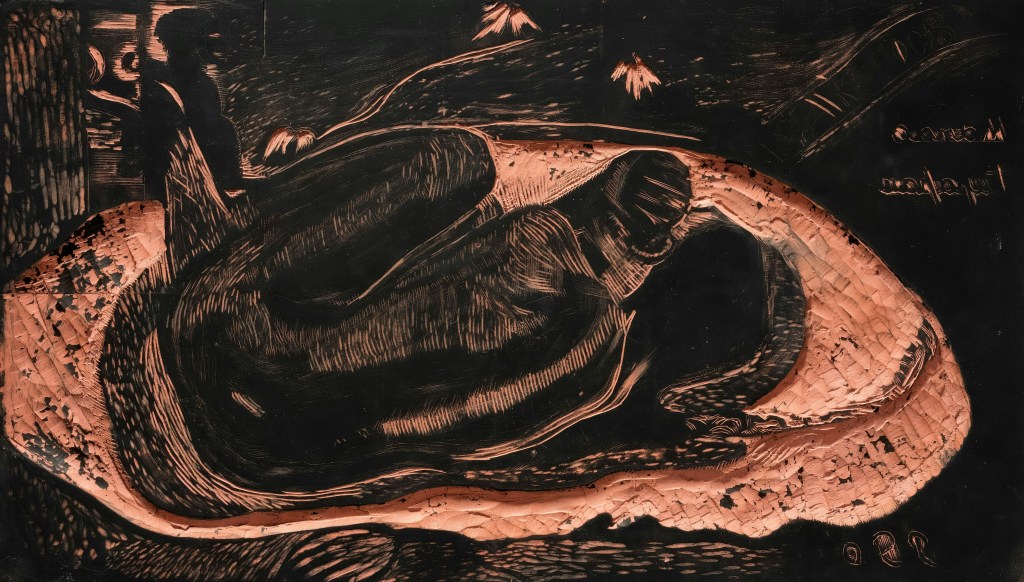
| featured picture: Artist Paul Gauguin Title Manao tupapau, Date 1893–1894 |






 Musings of a reading addict
Leave a comment