
Keywords: Pedro Páramo review, Juan Rulfo, Magical Realism, Latin American literature, favorite books, ghost town narrative, poetic short novels
Genre: Fiction, Magical realism
Length: short medium long
Country: Mexico
REVIEW
“There was no air; only the dead, still night fired by the dog days of August. Not a breath. I had to suck in the same air I exhaled, cupping it in my hands before it escaped. I felt it, in and out, less each time…until it was so thin it slipped through my fingers forever. I mean, forever.”
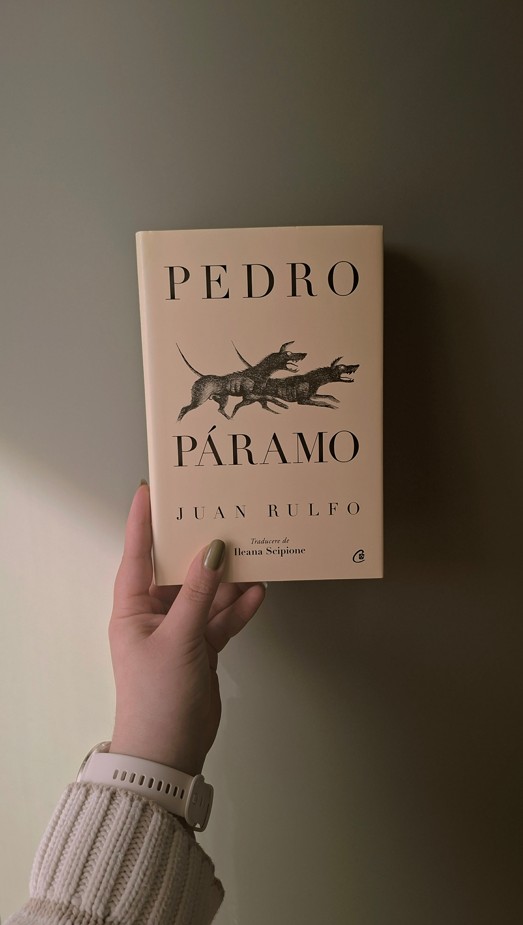
There are moments when reading simply stops working. You pick up book after book, and none of them manage to catch your attention for more than a few pages. I’ve learned that in times like this it rarely helps to keep starting new things. What works better, at least for me, is going back to the books I already love — the ones where I know there is something waiting to grab me again.
One of those books, one of my absolute favorites since I first read it in 2022, is Pedro Páramo by Juan Rulfo.
The first time I encountered it, I went in completely blind. I knew nothing about Rulfo, nothing about his influence, and nothing about his connection to Gabriel García Márquez. I simply saw the book in the library, liked the cover, picked it up, and started reading.
“The sky was filled with fat stars, swollen from the long night. The moon had risen briefly and then slipped out of sight. It was one of those sad moons that no one looks at or pays attention to. It had hung there a while, misshapen, not shedding any light, and then gone to hide behind the hills.”
The novel begins with a promise made to a dying mother. Before she passes away, she asks her son, Juan Preciado, to travel to the town of Comala and find his father, Pedro Páramo and to demand from him what he owed them all along. Juan sets off toward Comala, and that simple journey becomes the entrance into a world that is increasingly difficult to define.
Because Pedro Páramo does not follow the comfortable rules of storytelling. Characters appear and disappear. Voices shift without warning. At times it becomes nearly impossible to tell what is memory, what is dream, what is reality, and what belongs to something far more supernatural. The structure is fragmented, almost ghostlike in itself.
And strangely enough, that confusion is exactly what made me fall in love with it.
At the center of everything stands Pedro Páramo, a figure who is both magnetic and deeply unsettling. Through fragments of memories and voices, we slowly see the outline of a man shaped by obsession, power, cruelty, and a kind of destructive love. But the novel never simply tells you who he is. It lets you assemble him piece by piece, like an archaeologist reconstructing a broken statue.
What truly gets under your skin, though, is the prose.
This is technically a novel, but the writing carries the density and rhythm of poetry. The sentences are sparse and precise, yet they contain an extraordinary emotional weight. In just a few pages, Rulfo manages to create something that many much longer novels fail to achieve: an entire world that feels alive.
“I am lying in the same bed where my mother died so long ago; on the same mattress, beneath the same black wool coverlet she wrapped us in to sleep. I slept beside her, her little girl, in the special place she made for me in her arms. I think I can still feel the calm rhythm of her breathing; the palpitations and sighs that soothed my sleep. . . . I think I feel the pain of her death. . . . But that isn’t true. Here I lie, flat on my back, hoping to forget my loneliness by remembering those times. Because I am not here just for a while. And I am not in my mother’s bed but in a black box like the ones for burying the dead. Because I am dead. I sense where I am, but I can think. . .”
Within barely more than a hundred pages we encounter love stories, betrayals, revenge, political upheaval, obsession, murder, and something that almost feels like a thriller hidden beneath layers of memory. At the same time, the book quietly explores Mexican cultural beliefs about death and the afterlife, weaving together ancient traditions with the presence of Catholicism in rural life.
The result is a narrative that feels both intimate and mythic.
What amazes me every time I return to this book is how much it contains despite its size. The characters feel complete, the emotional arcs feel real, and the atmosphere of Comala — a town that seems suspended somewhere between life and death — stays with you long after the final page.
It’s rare to find a story that is this rich, this strange, and this beautifully written while remaining so concise.
For me, Pedro Páramo comes closer than anything else to perfection.




 Musings of a reading addict
Leave a comment