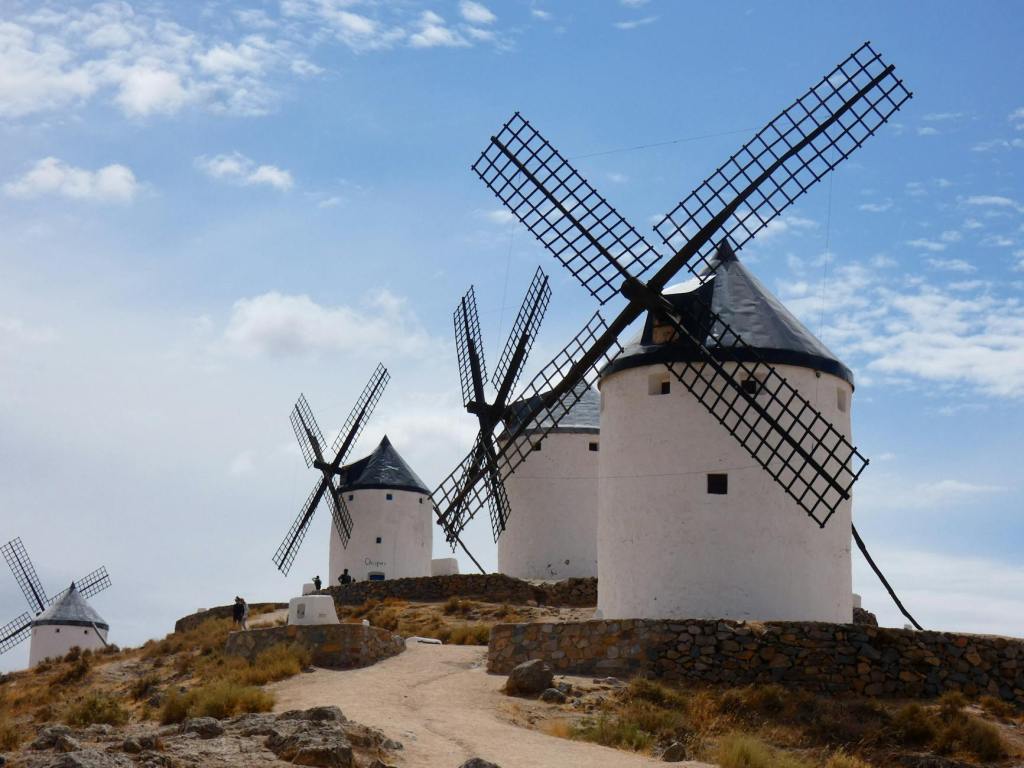
Keywords: Classic Literature, Long Classics, Satire, Philosophical Fiction, Character-Driven Story, Don Quixote de la Mancha,
Genre: Fiction
Length: short medium long
Country: Spain
REVIEW
“From so little sleeping and so much reading, his brain dried up and he went completely out of his mind.”
Don Quixote by Miguel de Cervantes had been sitting in my library for the longest time. It’s one of those titles that everyone knows about, but you don’t necessarily know HOW you know about it. My earliest memories of Don Quixote were basically just a vague mental image: a man on a horse holding a lance, with another person next to him, pointing at giant windmills. At the time I didn’t even know that the second character was a squire. I just knew there was a man, windmills, and the idea that he thought they were giants.
And honestly, this image never attracted me.
For me, it always seemed like a very confusing connection: some guy fighting windmills because he believes they are giants… but this is happening in a classic book that is not only famous but also over 700 pages long. So despite owning the book for years, I never actually wanted to read it.
How I Finally Picked It Up
That changed this January.
I was browsing StoryGraph and noticed that someone had started a read-along for Don Quixote. I thought this might finally be my chance to read it. My reasoning was simple: if I lost interest at some point, maybe the discussions with other readers would motivate me to continue.
And now, in March, here I am. I’ve finished Don Quixote.
And I have very mixed feelings.
A Surprisingly Funny Beginning
Once I actually started reading, the first surprise was just how funny the book is. I did not expect the sarcasm, I did not expect the irony, I definitely did not expect the humour.
And perhaps most surprising of all, I did not expect the flow. The book reads much easier than I had imagined.
One of the earliest lines perfectly sets the tone:
“From so little sleeping and so much reading, his brain dried up and he went completely out of his mind.”
I found that line hilarious, but also strangely relatable. Every reader knows the feeling of sacrificing sleep because there’s that one book/ series you just have to finish. For me, this happened with science fiction at one point. I became so obsessed with the genre that it was almost the only thing I read for a while, devouring massive books by Neal Stephenson — many of them over a thousand pages long. Well, read a lot and sleep too little for too long and that mental fog gets so serious your brain really does feel as if dried up. And you sorta go out of your mind – talking from experience.
So even though the premise of the novel is obviously absurd, I could actually understand the starting point.
And at the beginning, it really worked for me.
Don Quixote himself was endearing, Sancho was hilarious, and the endless series of encounters and side adventures kept things entertaining. Almost every character had some memorable gimmick, phrase, or personality trait that made the episodes stand out.
When the Length Becomes Too Much
But like everything in life, when something goes on for too long, it starts to lose its charm. By the second half of Part I, and honestly throughout most of Part II, I reached a point where I was thinking:
Don… I’ve had enough.
The problem was not the quality of the writing. It was the repetition. The cycle repeats itself again and again: a misunderstanding, a ridiculous adventure, humiliation, and then another encounter.
I’ve read long authors before. I’ve read Fyodor Dostoevsky, Leo Tolstoy, and Charles Dickens — writers famous for their massive novels. But this was the first time in my life reading a long classic where I reached a point and thought:
I cannot do this anymore. Please just let it end.
Again, this wasn’t about the book being bad. It was simply that the structure started to feel never-ending.
Moments of Unexpected Depth
What kept me going were the moments when the novel suddenly becomes philosophical and insightful.
One of the most memorable episodes involves Marcella, a beautiful young woman who is blamed for the suicide of a man who loved her. When she finally speaks, she delivers an extraordinary defense of her freedom and dignity, arguing that she cannot be held responsible for the feelings men project onto her.
The speech is surprisingly modern and incredibly logical. It stands in stark contrast to the chaotic comedy happening around it.
Another remarkable moment comes in Part II, Chapter 42, when Don Quixote gives advice to Sancho, who is about to take on an important responsibility.
For a brief moment, the supposedly “mad” knight becomes the most rational person in the room.
Some of his advice includes lines like:
“Never let yourself be guided by arbitrary law, which is so favored by the ignorant who think they’re clever.”
And:
“Try to discover the truth among the promises and gifts of the rich, as well as among the sobs and pleadings of the poor.”
And perhaps my favorite:
”When equity can and should find favour, don’t put the whole weight of the law on the delinquent, because the fame of the severe judge is no more than that of the compassionate one.”
These passages reveal something fascinating about Don Quixote. Even within his madness, he embodies a kind of moral clarity.
Reality vs. Illusion
One of the central themes of the novel is the constant tension between reality and illusion.
Don Quixote chooses to reinvent his life completely. He renames himself Don Quixote de la Mancha, renames his horse Rocinante, invents a beloved lady called Dulcinea del Toboso, and dedicates himself to reviving knighthood.
What makes the theme interesting is that although he lives inside a fantasy, his moral values often appear superior to those of the supposedly sane people around him. In other words, the person everyone calls an idiot sometimes behaves more nobly than the people mocking him.
The novel also plays with layers of illusion. Some characters actively exploit Don Quixote’s fantasies by pretending that his imagined world is real.
One of the absurd examples (though there are SO MANY) involves a wooden horse. Two characters convince Don Quixote that he must fly on a magical horse to defeat a magician who cursed a group of women with beards. They blindfold him and Sancho, place them on the wooden horse, blow air at them to simulate flight, and then pretend that the mission has been accomplished.
When I read this scene, I honestly couldn’t believe what I was reading. It felt like the most ridiculous sketch imaginable — something you would expect to find on YouTube rather than in a 17th-century classic. It was funny, but also so exaggerated that it pushed the absurdity almost too far.
Idealism vs. Pragmatism
If there is something that truly holds the novel together, it is the dynamic between Don Quixote and Sancho Panza. They represent two opposite worldviews:
Don Quixote embodies idealism — honor, courage, and moral purity.
Sancho represents pragmatism — survival, comfort, money, and domestic happiness.
Sancho doesn’t care about grand ideals. He wants wealth, stability, and to keep his wife happy. Their constant banter and arguments create some of the most entertaining moments in the book. Without this contrast, the story would probably collapse under its own weight.
Comedy or Tragedy?
Some readers interpret Don Quixote as a great comedy, while others see it as a tragedy. Personally, I think it is both at the same time.
At first, everything feels purely comedic. A man reads too many chivalric romances and decides to become a knight. He renames himself, renames his horse, invents a lady who doesn’t even know he exists, and sets out on ridiculous adventures. It’s absurd, and you laugh. But as the story continues — and especially once certain characters begin deliberately manipulating him — the tone changes. The laughter slowly becomes uncomfortable.
You start realizing that what you are watching is not just a series of jokes. It’s the story of a man who, by modern standards, would probably be diagnosed with a psychological disorder. And when people exploit that condition for entertainment, the story stops being funny and becomes something much darker.
By the time you reach the ending, you start wondering:
Was Don Quixote truly unaware of what was happening around him?
Or was the illusion something he consciously chose, refusing to abandon the world he had created?
Another aspect of the tragedy that struck me while reading this book reminded me strongly of The Idiot by Fyodor Dostoevsky. In that novel, Prince Myshkin is also a character defined by sincerity, kindness, and an almost radical moral purity — and yet these qualities are precisely what make him appear ridiculous to the society around him. I felt something very similar happening with Don Quixote.
The tragedy is not only in the pranks played on him by the Duke and Duchess or in the absurd situations he constantly finds himself in. It is also in the uncomfortable realization that the values he fights for — honor, justice, dignity, courage — often feel completely out of place in the practical, cynical reality of everyday life. His worldview is treated as madness not only because of his delusions, but because the principles themselves seem naive, exaggerated, and almost comically unrealistic when placed next to ordinary human behavior. In that sense, the laughter surrounding Don Quixote is not directed only at the man, but almost at the very idea that someone could still believe in such uncompromising moral ideals.
My Final Thoughts
From a purely subjective point of view, I have to be honest:
I did not love Don Quixote.
For me, it was simply too long, too repetitive, and at times exhausting. But there are books that are objectively great, even if we personally struggle with them. And Don Quixote is absolutely one of those books. My personal enjoyment doesn’t change the fact that this novel is brilliant, insightful, and incredibly important in literary history.
Would I say I enjoyed it completely?
No.
Would I say it entertained me the entire time?
Definitely not.
But would I still recommend it?
Absolutely.
Reading Don Quixote is an experience, and it’s one that I think every reader should have at least once.
So if you’re curious, get your hands on it. Maybe join a read-along if that helps you stay motivated. Even if you don’t end up loving it, you will still have experienced one of the most influential books ever written.
And honestly, that alone makes it worth the effort.
“When life itself seems lunatic, who knows where madness lies? Perhaps to be too practical is madness. To surrender dreams — this may be madness. Too much sanity may be madness — and maddest of all: to see life as it is, and not as it should be!”







 Musings of a reading addict
Leave a comment